Deck Construction Companies Near Me: Big vs Small Contractors
About the Author: This article was researched and written by
SFWebTech,
a digital marketing agency specializing in home services websites and SEO content.
When you start searching for deck construction companies near me, you’ll quickly discover the market is crowded. Large regional companies with polished websites sit alongside one-person operations with decades of experience. Both can build a beautiful deck. Both can also disappoint you if you pick the wrong one for your specific situation.
This article breaks down exactly how to evaluate local deck building services, what separates national franchise builders from independent residential deck contractors, and how to make the right call based on your project type, budget, and timeline. Whether you’re in suburban Pennsylvania or anywhere across the United States, the principles here apply.
Key Takeaways
Deck construction companies near me vary widely in size, price, and service quality.
Large contractors often offer streamlined processes but may lack personalized communication.
Small local deck builders frequently provide hands-on craftsmanship and flexible pricing.
Checking deck builder reviews near me helps filter out underqualified contractors before you commit.
Pennsylvania homeowners have access to both regional firms and independent residential deck contractors.
Always verify licenses, insurance, and portfolio before signing any agreement.
Understanding the Landscape of Deck Builders Near Me
Who’s Actually Out There?
When you search for deck builders near me, results typically fall into four categories:
Large regional or national companies — Often franchises or multi-crew operations handling dozens of projects simultaneously.
Mid-size local contractors — Established businesses with 5–15 employees, typically serving a defined metro area.
Small owner-operator businesses — One to four people, often the owner is on-site daily.
General contractors offering deck work — Broader remodelers who include deck construction as one of many services.
Each category has a different risk and reward profile. Knowing which one you’re dealing with before you sign anything is essential.
Why Location Still Matters for Deck Work
Deck construction is inherently local. Building codes, permit requirements, and climate conditions vary by municipality. A company that understands Pennsylvania frost line requirements or local HOA restrictions will build a safer, more compliant deck than one applying one-size-fits-all specs. Homeowners relying on professional deck installers in Pennsylvania understand these regional nuances firsthand, ensuring structures are built to withstand local weather patterns and code specifics.
Big Contractors: Strengths and Limitations
What Large Deck Companies Do Well
Large deck construction companies typically offer:
Standardized processes — Estimating, permitting, and scheduling are handled through established workflows.
Speed — More crews mean faster start dates and shorter build windows in many cases.
Warranty programs — Larger companies often offer more formalized warranty structures.
For homeowners with straightforward projects — a basic rectangular deck using standard materials — large companies can be efficient and cost-effective.
Where Big Companies Fall Short
Large operations also carry known weaknesses. Communication can become fragmented when you’re one of fifty active projects. The salesperson who sold you the deck may never appear again. Subcontractors brought in for specific phases may not share the same standards as the core team.
Many homeowners report that after signing a contract with a larger firm, their primary point of contact changes multiple times before the project completes. That’s not universal, but it’s a common thread in deck builder reviews near me across review platforms like the Better Business Bureau and Houzz.
Small Contractors: Strengths and Limitations
What Small Local Deck Builders Offer
Independent or small-crew local deck building services offer a different set of advantages:
Direct owner involvement — You often work directly with the person swinging the hammer.
Custom craftsmanship — Smaller teams tend to take pride in detail work, especially on complex or custom designs.
Flexibility — Scheduling and design changes are easier to accommodate.
Community accountability — Local reputation matters more to a small business; word-of-mouth is their lifeline.
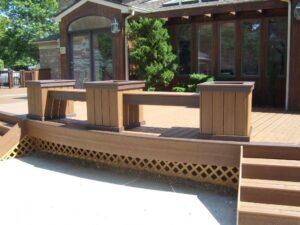
For homeowners wanting custom pergola designs and built-in seating, or other custom features, searchers often find that smaller shops deliver superior results at competitive prices.
Where Small Shops Can Struggle
Small contractors aren’t without risk. Cash flow limitations can cause project delays. If the owner gets sick or a key crew member leaves, your project stalls. Some smaller operations lack the insurance coverage or licensing documentation that larger firms maintain as a matter of course.
Always request a Certificate of Insurance before any work begins — regardless of company size.
Side-by-Side Comparison Table
Factor
Large Contractor
Small Contractor
Price
Often higher base cost
Frequently more negotiable
Timeline
Faster scheduling (more crews)
Depends on workload
Customization
Limited to package offerings
Highly flexible
Communication
Often through office staff
Direct owner contact
Warranty
Formal written programs
Varies widely
Local code knowledge
May use general standards
Usually deeply local
Insurance & licensing
Typically well-documented
Verify independently
Personal accountability
Moderate
High
How to Evaluate Any Deck Construction Company Near Me: A Step-by-Step Process
Step 1: Define your project scope first. Know approximately what size deck you want, preferred materials (pressure-treated lumber, composite, hardwood), and any special features before you call anyone. This makes estimates more accurate and comparable.
Step 2: Search and shortlist. Use search engines, the National Association of the Remodeling Industry (NARI), and local community boards to generate 4–6 candidates. Look specifically for residential deck contractors with demonstrated local experience.
Step 4: Request itemized written estimates. Never compare lump-sum quotes. Ask each company to break down materials, labor, permit fees, and cleanup separately. This reveals where cost differences actually come from.
Step 5: Read deck builder reviews near me — carefully. Look beyond star ratings. Read the 3-star reviews. Look for patterns in complaints: communication problems, timeline overruns, material substitutions. One bad review in 50 is noise; five similar complaints is a pattern.
Step 6: Ask for a portfolio and references. Request to view our portfolio of completed projects or ask potential contractors to see at least three completed projects similar to yours. Contact references directly and ask specifically about how problems were handled — every project has something go sideways; the real test is the response.
Step 7: Review the contract line by line. Confirm the scope of work, payment schedule (avoid companies demanding more than 30–40% upfront), change order procedures, and warranty terms are all in writing before signing.
Pros and Cons Summary
Large Deck Construction Companies
Pros:
Structured warranties and formal processes
Multiple crews for faster turnaround
Established vendor relationships for materials
Easier financing options in some cases
Cons:
Less personalized service
Higher likelihood of subcontractor use
Communication can feel bureaucratic
Less flexibility for custom work
Small/Local Residential Deck Contractors
Pros:
Owner often on-site daily
Greater flexibility for custom and complex designs
Higher accountability to local reputation
More room for negotiation
Cons:
Limited crew size can cause delays
May have less formal warranty documentation
Insurance and licensing require independent verification
Harder to assess financial stability for large projects
Do’s and Don’ts When Hiring Deck Builders Near Me
DO:
Get at least three written, itemized estimates
Verify licensing through your state’s contractor registry
Ask specifically who will be on-site daily
Confirm permit pulling is included in the contract
Check references from similar-sized projects
DON’T:
Choose based on price alone
Pay more than 40% upfront before work begins
Assume a polished website means quality work
Skip the contract review because you trust someone
Accept verbal promises about timelines or materials
Conditional Guidance: Which Type Is Right for You?
If you need a straightforward rectangular deck on a standard lot: A larger company with a streamlined process can deliver efficiently and cost-effectively. Their standardized systems work well for uncomplicated scopes.
If timeline is your primary concern: Larger companies with multiple crews can often mobilize faster — but confirm actual start dates in writing, not just estimates.
If budget is your primary concern: Small contractors often have lower overhead and more flexible pricing, particularly for labor. Get itemized quotes from both types to compare accurately.
Case Study: The Hoffmans’ Deck Decision
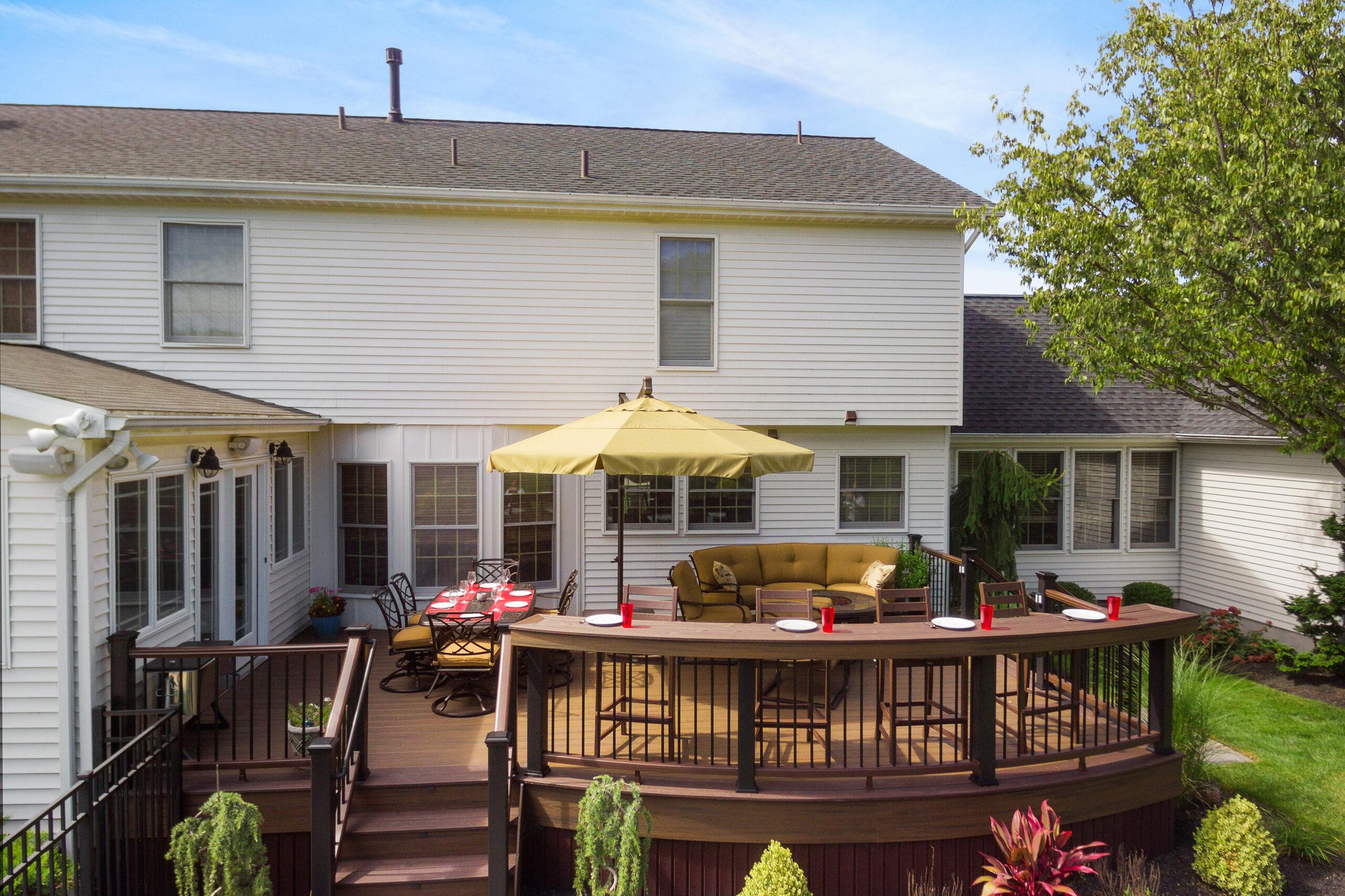
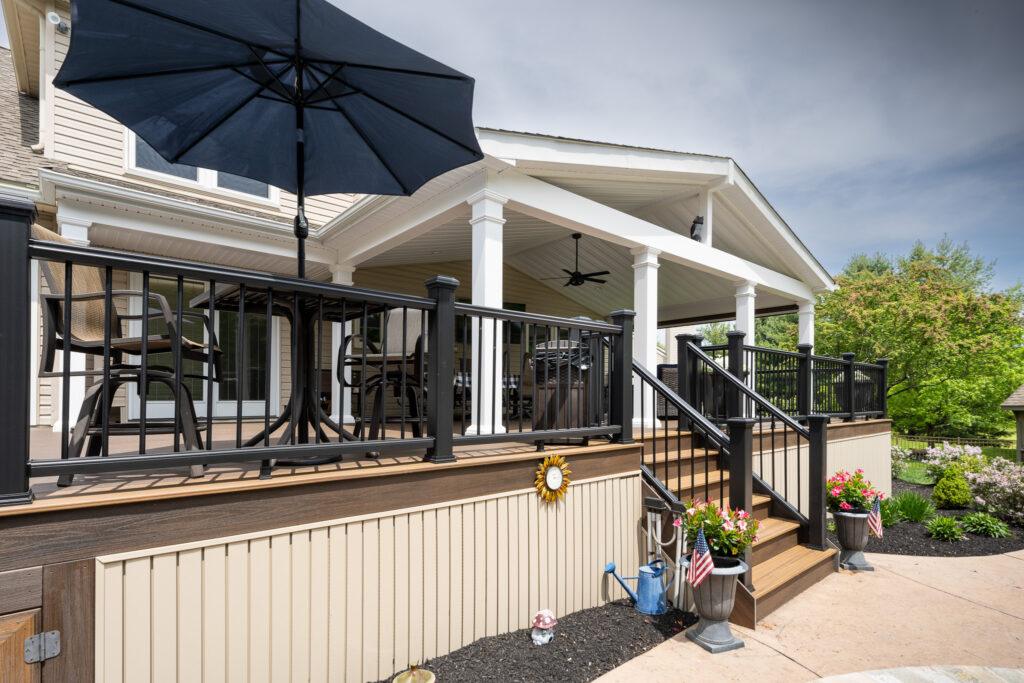
The Hoffman family in suburban Chester County, Pennsylvania wanted a 400-square-foot composite deck with cable railing and a pergola overhead. They got four quotes ranging from $28,000 to $44,000.
The two high quotes came from larger regional companies. Both offered formal warranties and faster proposed timelines. The two lower quotes came from small owner-operated contractors. One had poor reviews regarding communication. The other had spotless references and an extensive portfolio of similar builds.
The Hoffmans chose the smaller contractor with strong references. The owner was on-site every day, adjusted the pergola placement when they changed their minds mid-project, and finished two days ahead of schedule. The warranty was less formal, but the workmanship was exceptional.
The lesson: price and company size are inputs, not conclusions. Due diligence is what actually determines outcomes.
Quick Answers – FAQ
Q: How do I find reputable deck construction companies near me? Start with NARI’s contractor finder, state licensing databases, and reviews on platforms like Houzz or the BBB. Ask neighbors for direct referrals — first-hand experience is the most reliable signal.
Q: What should deck builders near me include in a written estimate? A proper estimate should itemize materials, labor, permit fees, site preparation, debris removal, and any subcontractor work separately. Avoid contractors who only provide lump-sum figures.
Q: Are small local deck builders insured? Not always automatically. Always request a current Certificate of Insurance showing general liability and workers’ compensation before any work begins, regardless of company size.
Q: How much does a residential deck contractor typically charge in Pennsylvania? Costs vary widely based on size, materials, and complexity. Pressure-treated lumber decks generally cost less than composite builds. Always get multiple itemized quotes to understand your local market.
Q: What’s the difference between a deck builder and a general contractor? A deck builder specializes specifically in deck construction and typically has deeper expertise in materials, structural requirements, and design options. A general contractor may offer deck work as one of many services, with varying depth of specialization.
Q: How long does deck construction typically take? A standard residential deck usually takes between three days and two weeks depending on size, complexity, and crew size. Custom builds with pergolas or multi-levels take longer. Always get a timeline in writing.
Q: What questions should I ask when checking deck builder reviews near me? Look for patterns around communication, timeline adherence, material quality, and how problems were resolved. Five similar complaints across different reviewers signal a real issue.
Q: Do I need a permit for a new deck in Pennsylvania? In most Pennsylvania municipalities, yes — any deck attached to a home or over a certain height requires a building permit. Your contractor should handle permit pulling; verify this is in the contract. Compliance with International Residential Code standards for deck construction is critical for safety.
Q: Is composite decking worth the extra cost over pressure-treated wood? Industry experts suggest composite decking typically lasts longer with less maintenance, making it cost-effective over a 15–20 year horizon despite higher upfront costs. To understand the long-term value of composite vs. wood decking, consider factors like annual maintenance time and replacement cycles. For short-term budgets, pressure-treated wood remains a solid option.
Q: What percentage upfront is normal for deck contractors? A deposit of 25–40% at signing or project start is standard in the industry. Be cautious of any contractor requesting more than 50% before substantial work begins.
Glossary of Terms
Composite Decking: A building material made from a blend of wood fibers and recycled plastic. It resists rot, splintering, and fading better than natural wood, though it carries a higher upfront cost.
Frost Line: The depth to which the ground freezes in winter in a given geographic area. Deck footings must extend below the frost line to prevent structural movement — a critical factor for professional deck installers in Pennsylvania and other cold-climate states. Adhering to International Residential Code standards for deck construction ensures footings are dug to the correct depth.
Change Order: A written amendment to the original construction contract that documents any modification to scope, materials, or cost. All changes should be documented this way to protect both parties.
Certificate of Insurance (COI): A document issued by an insurance company verifying that a contractor carries active coverage for general liability and workers’ compensation. Homeowners should request this before any contractor begins work.
Conclusion
Whether you ultimately hire a large regional operation or a small owner-operated shop, the most important thing you can do is treat the selection process with the same seriousness as the investment itself. Deck construction companies near me vary enormously in quality, reliability, and value — and company size is not a reliable shortcut to predicting any of those things.
Big companies offer structure and speed. Small companies offer craftsmanship and flexibility. The right choice depends entirely on your project, your priorities, and the specific individuals standing behind each quote you receive.
Do your research, verify credentials, read reviews critically, and get everything in writing. A well-built deck adds meaningful value to your home and years of enjoyment to your life. The contractor you choose is the single biggest variable in that outcome.
Ready to start comparing quotes? Use the checklist in this article to evaluate every deck contractor you speak with — and don’t skip the reference calls.