Hiring professional deck installers in Pennsylvania typically saves time, ensures code compliance, and adds lasting home value—but DIY can work for smaller, simpler projects if you have the skills and patience.
Key Takeaways
- Professional deck installers vs DIY is a decision that affects your budget, safety, and home value.
- Pennsylvania requires permits for most deck builds; professionals handle this process automatically.
- Labor accounts for a significant portion of total deck costs—DIY can cut this, but skill gaps add risk.
- Local deck building services offer warranties and liability coverage that DIY projects lack.
- If you need a multi-level or complex structure, choosing residential deck contractors is strongly advised.
- Always verify contractor credentials, insurance, and deck builder reviews near me before signing.
Why This Decision Matters More Than You Think
Every spring, Pennsylvania homeowners face the same tempting question: should I hire professional deck installers, or save money and build it myself? It sounds simple on the surface, but the answer depends on a web of factors—local building codes, your skill level, project complexity, long-term resale value, and how much your weekends are worth.
This guide breaks down the real costs, risks, and rewards of both paths. Whether you’re searching for the best deck builders in Pennsylvania or ready to grab a drill and build something yourself, you’ll find the honest, practical information you need right here.
Understanding the Full Cost: Professional vs. DIY
One of the biggest myths in home improvement is that DIY is always cheaper. When you account for tool rentals, material waste, permit fees, and the cost of fixing mistakes, the gap narrows considerably.
Industry experts suggest that professional deck installation in Pennsylvania typically runs between $25 and $50 per square foot for pressure-treated wood, and higher for composite materials. A 300-square-foot deck could therefore cost anywhere from $7,500 to $15,000 or more when professionally built. DIY projects can reduce this by 30–50% in labor savings, but only if you have the right tools, experience, and available time. For those weighing their options, comparing your decking material options can help clarify the long-term value difference between wood and composite.
Labor is the biggest variable. Residential deck contractors charge for their expertise, tools, project management, and accountability. When you DIY, you’re essentially providing that labor for free—but free labor isn’t without cost if it leads to errors, delays, or failed inspections. If you are considering composite, viewing a detailed breakdown of Trex decking costs can help you plan your budget accurately.
Comparison Table: Professional Deck Installers vs. DIY
| Factor | Professional Deck Installers | DIY |
|---|---|---|
| Upfront Cost | Higher (includes labor) | Lower (materials only) |
| Time to Complete | 1–3 weeks (typical) | 4–8+ weekends |
| Permit Handling | Usually included | Homeowner’s responsibility |
| Code Compliance | Professionally managed | Risk of errors |
| Warranty | Often 1–5 years | None |
| Liability Coverage | Contractor’s insurance | Homeowner’s risk |
| Quality Consistency | High | Varies by skill |
| Resale Value Impact | Strong | Depends on workmanship |
Pennsylvania’s Permit Requirements: A Critical Factor
Pennsylvania’s official Uniform Construction Code (UCC) requires permits for most deck projects attached to a home or elevated more than 30 inches above grade. Many municipalities enforce this strictly, and unpermitted decks can cause real problems at resale—or worse, during a homeowner’s insurance claim.
When you hire professional deck installers in Pennsylvania, they typically pull the permit on your behalf, schedule inspections, and ensure the build meets local standards. When you DIY, every one of those responsibilities falls on you. To navigate this process safely, consider consulting our guide on how to hire a deck contractor to understand what verified professionals handle for you.
If you need to sell your home within the next few years, a properly permitted deck is non-negotiable. Buyers’ inspectors will identify unpermitted structures, and you may be forced to retrofit or remove the deck entirely. The Pennsylvania Department of Labor & Industry provides guidance on residential permit requirements through its UCC resources.
Step-by-Step: How Professional Deck Installers Work
Understanding the professional process helps you evaluate what you’re actually paying for.
- Initial Consultation and Site Assessment — A reputable contractor visits your property, evaluates drainage, soil conditions, sun exposure, and how the deck will connect to your home’s structure.
- Design and Material Selection — Contractors present design options that fit your budget and lifestyle. Material choices—pressure-treated lumber, cedar, composite, or PVC—are discussed with realistic cost comparisons.
- Permit Application — The contractor submits plans to your local building authority and schedules required inspections.
- Site Preparation — Ground clearing, utility marking (important in Pennsylvania, where you must contact the PA One Call system at 811 before any digging), and layout work begin.
- Footings and Foundation — Concrete footings are poured to below the frost line. Pennsylvania’s frost depth averages 36 inches, which is deeper than many states and a critical factor in deck longevity.
- Framing and Ledger Attachment — The structural skeleton is built and securely attached to the home’s band joist using approved hardware. Improper attachment here is a leading cause of failure; see common signs that a deck needs rebuilding to understand the risks.
- Decking Installation — Surface boards are installed according to the design plan, with proper spacing for drainage and expansion.
- Railing, Stairs, and Finishing — Guardrails (required for decks over 30 inches) and stairs are built to code. Learn more about choosing the best deck railings for safety and style as part of this phase. Finish work, sanding, and any requested staining or sealing follow.
- Final Inspection — The local building inspector signs off, and the contractor addresses any punch-list items.
- Handoff and Documentation — You receive warranty paperwork, care instructions, and permit documentation for your records.
Pros and Cons: Hiring Professional Deck Installers
Pros
- Code compliance is managed for you — no guessing about joist spans, post depths, or railing heights
- Warranty protection — most local deck building services offer workmanship warranties
- Faster timeline — a professional crew completes in days what takes a homeowner months
- Access to bulk material pricing — contractors often buy at trade discounts
- Liability coverage — if a worker is injured on your property, a properly insured contractor protects you
- Resale value — professionally built decks pass inspection and appeal to buyers
Cons
- Higher upfront cost — labor adds significantly to the total bill
- Scheduling constraints — quality deck construction companies near me often book weeks or months in advance
- Less personal control — some homeowners prefer to make real-time decisions during the build
- Variability in contractor quality — not all builders are equal; checking deck builder reviews near me is essential
Pros and Cons: DIY Deck Building
Pros
- Significant cost savings — especially on straightforward, ground-level projects
- Personal satisfaction — many homeowners find deep value in building something themselves
- Complete design control — you can adjust plans freely as you go
- No scheduling dependency — work at your own pace
Cons
- Permit and inspection burden — entirely your responsibility
- Structural risk — improper footings, ledger attachment, or joist sizing can lead to collapse. Review common signs that a deck needs rebuilding to see what happens when these steps go wrong.
- Time investment is substantial — most DIY decks take far longer than expected
- Tool costs — post hole diggers, circular saws, and drill equipment add up if not already owned
- No warranty on workmanship — any mistakes are yours to fix
Do/Don’t List for Pennsylvania Deck Projects
DO:
- Do pull a permit before breaking ground, regardless of who builds
- Do call PA One Call (811) before digging any footings
- Do verify that any contractor carries general liability and workers’ comp insurance
- Do check online deck builder reviews near me and ask for local references
- Do get at least three written quotes from residential deck contractors
DON’T:
- Don’t skip the permit to save money—it creates bigger problems at resale
- Don’t hire the cheapest bidder without verifying credentials
- Don’t assume a DIY deck will automatically pass inspection
- Don’t build in winter without understanding how frost affects concrete curing
- Don’t rely on verbal agreements—get everything in writing
Conditional Reasoning: When Each Option Makes Sense
If you are building a simple, ground-level platform deck under 200 square feet and have experience with basic carpentry, a DIY approach is reasonable. The structural demands are lower, permit requirements may be simpler, and the risk of costly errors is reduced.
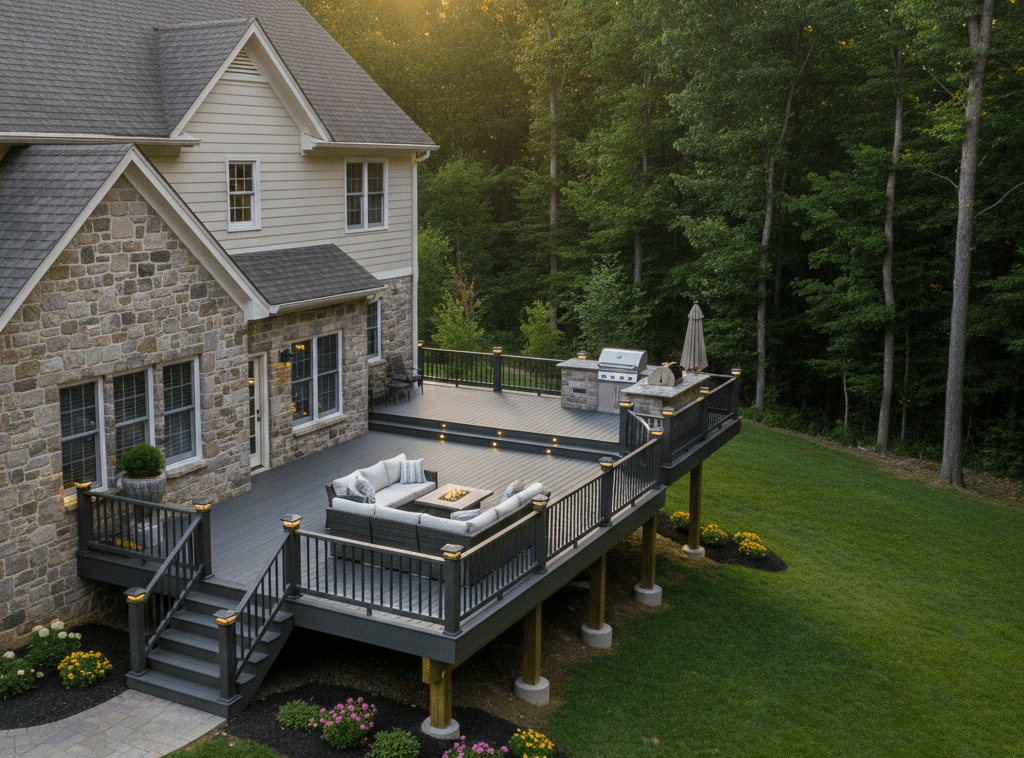
If you need a multi-level deck, rooftop deck, deck with built-in features like design tips for unique pergola structures or ideas to update your deck with an outdoor kitchen, or any structure attached to a second story, hiring the best deck builders in Pennsylvania is strongly advisable. The structural engineering complexity, load calculations, and code compliance requirements in these scenarios create real risk for inexperienced builders.
If you plan to sell your home within five to seven years, a professionally built and permitted deck typically returns more value than a DIY project of equivalent size, according to real estate industry data compiled in the National Association of Realtors’ annual Cost vs. Value Report.
A Hypothetical Case Study: The Walkers of Lancaster County
(Hypothetical scenario for illustrative purposes.)
The Walker family wanted a 400-square-foot composite deck on the back of their split-level home in Lancaster County, Pennsylvania. After getting quotes from three local deck building services ranging from $14,000 to $19,500, they seriously considered DIY to save money.
Their initial material estimate came in around $6,800. However, after factoring in tool rentals, a post hole digger, concrete, hardware, and a permit application, their revised estimate hit $9,200—before a single board was placed. They also realized that the ledger attachment on a split-level required specific flashing and hardware to meet Pennsylvania UCC requirements—something they weren’t confident handling, especially after seeing real-world examples of wood vs. Trex longevity.
They hired a residential deck contractor at $16,500. The project was complete in eight days, passed inspection on the first try, and came with a three-year workmanship warranty. Two years later, their real estate agent credited the deck with supporting a faster sale at a competitive price.
Quick Answers – FAQ
Q: How do I find the best deck builders in Pennsylvania?
Search for “deck builders near me” with reviews on Google, Houzz, or the Better Business Bureau. Always verify licensing through the Pennsylvania Attorney General’s Home Improvement Contractor registration database, or follow our guide on how to hire a deck contractor for a step-by-step vetting process.
Q: Do I need a permit to build a deck in Pennsylvania?
Most decks attached to a home or elevated over 30 inches above grade require a permit under Pennsylvania’s Uniform Construction Code. Contact your local municipality to confirm requirements.
Q: How long does professional deck installation take?
A standard residential deck typically takes one to three weeks from permit approval to completion, depending on size and complexity.
Q: Is DIY deck building legal in Pennsylvania?
Yes, homeowners may generally build their own decks, but they must obtain permits, pass inspections, and comply with all local codes just as a contractor would.
Q: What questions should I ask residential deck contractors?
Ask about licensing, insurance, permit handling, material warranties, project timeline, payment schedule, and whether they pull permits or expect you to.
Q: How much does a deck add to home value in Pennsylvania?
Industry research from the National Association of Realtors suggests wood decks return a significant portion of their cost at resale. Composite decks often return even more due to low maintenance appeal.
Q: What is the frost line depth in Pennsylvania, and why does it matter?
Pennsylvania’s average frost depth is approximately 36 inches. Deck footings must extend below this depth to prevent heaving and structural movement over time.
Q: Can I save money by doing part of the work myself and hiring out the rest?
Yes. Many deck construction companies near me offer partial contracts. You might handle site clearing, material pickup, or finishing work while the contractor handles structural framing and inspections.
Q: What should I look for in deck builder reviews near me?
Look for consistent mentions of communication, on-time completion, clean job sites, permit management, and responsiveness to warranty issues after project completion.
Q: What materials are most popular for Pennsylvania decks?
Pressure-treated lumber remains the most common due to cost. Composite decking (brands like Trex and TimberTech) is increasingly popular for low maintenance. Cedar and redwood are premium natural options.
Glossary of Terms
Ledger Board: The structural board that attaches a deck directly to the home’s framing. Improper ledger attachment is one of the most common causes of deck collapse, making it a critical inspection point.
Frost Line: The maximum depth at which ground moisture freezes in a given climate zone. In Pennsylvania, footings must reach below this depth—typically 36 inches—to ensure the deck doesn’t shift with seasonal ground movement.
PA One Call (811): Pennsylvania’s utility notification system. By law, anyone planning to dig must call 811 at least three business days before excavating to have underground utility lines marked.
Uniform Construction Code (UCC): Pennsylvania’s statewide building code that governs residential construction including decks, adopted from the International Residential Code (IRC) with state-specific amendments.
Conclusion
For most Pennsylvania homeowners, the answer is yes—especially for decks attached to the home, elevated structures, composite material projects, or any build where resale value and long-term safety matter. Professional deck installers bring permits, warranties, liability protection, and code expertise that simply cannot be replicated by watching tutorial videos on a weekend.
That said, DIY isn’t out of the question. For smaller, ground-level projects where you have genuine carpentry experience and time to invest, the savings can be real and the satisfaction is undeniable.
The smartest move? Get written quotes from at least three deck construction companies near me, read genuine deck builder reviews near me, and compare those numbers honestly against your DIY material estimate—tools, permits, and time included. Only then will you have the full picture.
Ready to take the next step? Contact a licensed local deck building service today for a free consultation and written estimate.